Label Cloud

Posts tonen met het label Terry Pratchett. Alle posts tonen

zaterdag 11 oktober 2008

Good Omens

Terry Pratchett & Neil Gaiman's Good Omens tells the story of the coming of the End Times. The Anti-Christ is born and soon the Four Horsemen of the Apocalypse, Famine, War, Pollution (Pestilence retired in 1936 after the discovery of penicillin) and Death, will be here to start off the Great War between Heaven and Hell. The problem is that the Angel Aziraphale (who used to have a fiery sword of justified vengeance, but thosee humans looked so cold) and the demon Crowley (who hisses slightly when he talks and had something to do with an apple and a tree) like the Earth the way it is. So, these unlikely long-time friends try to stop it from happening. The child who they think is the Son of Satan, is however a normal human. Due to a mix-up at birth, involving babbling satanist nuns, the Anti-Christ ends up growing up as a relatively normal child in Lower Tadfield, England. And so the race against time begins ...

The book was written when Terry Pratchett's star was starting to rise and Neil Gaiman was working on the Sandman graphic novels. Since then, the book has acquired somewhat of a cult status. Luckily I didn't know all of this when I started reading it. I've been a fan of Pratchett's work since a friend of mine introduced me to the Colour of Magic while studying (ahem) at the university. I only knew Neil Gaiman by name (I had heard of Sandman and American Gods), but I think I will become a fan of his work as well. Although there are some typical Pratchettisms in there, it is most definitely not a Discworld novel. The book has its own pace and character. What is very clear is that the combination of styles works very well.

Good Omens makes fun of the way people act towards one another and the planet (and a little bit of religion). The ending is so wonderfully naïve as to give you hope. But, although the story in itself is very nice, the most interesting part is the depiction of the characters. The story betrays a deep insight into people's motivations, hopes and frustrations. Definitely a must read. And now, to the bookstore to buy American Gods and some more Discworlds.

dinsdag 5 augustus 2008

Discworld: Moist von Lipwig books

In Going Postal Terry Pratchett has introduced the character Moist von Lipwig into the Discworld universe. Lipwig is a petty con artist who, at the 'request' of Lord Vetinari, the absolute ruler (Patrician) of the city of Ankh-Morpork, has taken on the daunting task of getting the city's run-down post office going again. To accomplish this, he uses his sense of showmanship to launch a number of initiatives. One of these is the invention and production of paper stamps. These can be bought here by the way. There is also a fan page and a dedicated forum. Inevitably he comes into conflict with the clacks (Discworld version of the telegraph) company the Grand Trump, which is run by shrewd and cruel businessmen (most notably the chairman Reacher Gilt). With his flamboyant style and daredevil attitude Lipwig, as Postmaster General, gets the job done.

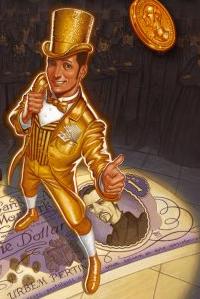
At the beginning of the second book in the series, Making money, Lipwig has turned the post office into a smoothly operating machine. He is also betrothed to the love interest of the previous book, Adora Belle Dearheart, the cynical, chain-smoking, tough mama, employee and advocate of the Golem Trust Fund. The crimes of the past have been forgotten, he's got himself a woman, he's even become somewhat of a respected citizen. He's got everything a man could wish for ... and he's bored. Vetinari alleviates this problem by introducing him to Topsy Lavish, the elderly chairwoman of the Royal Bank of Ankh-Morpork and the Royal Mint. The next day she dies. She has left the majority of the shares and the chairmanship to her dog Mr. Fusspot, who is placed in the care of Lipwig. Cosmo Lavish, an incredibly ambitious member of the family is not very happy with this choice and tries to undermine Lipwig's efforts to make the Bank a respected institution again. As the story unfolds Lipwig once again proves to be innovative. He creates paper money (picture) and ends up replacing the gold standard by ... something else (wouldn't wan to ruin the fun).

The basic backbone of the larger story is more or less the same as the first books of the City Watch series. The main character is down and out. Out of necessity he picks himself up and becomes a useful member of society. Then he gets bored, but luckily a new challenge presents itself. If a third book will appear, Lipwig will probably get married in that one. That being said, this new series is different in the portrayal of characters. The con man with his devious ways, the obsessive postal employee Stanley and the absolutely mad Cosmo Lavish, make both books very enjoyable reads. As always, Pratchett portrays a deep insight into the Western world in general and human psychology in particular. Long time fans will definitely not be disappointed. For those who are not familiar with the Discworld, this would make a good introduction. The story's focus is less on magic than usual, while the themes are universal in nature, making it enjoyable to people who aren't really into fantasy.

zaterdag 26 april 2008

The colour of magic

Sky One has already made a movie adaption of Terry Pratchett's Hogfather. This Easter they have released the man's first novel, the colour of magic. And once again it looks good. I'll be watching it soon.

You can see a trailer on the official site. The two parts can be seen here and here. Enjoy!

P.S.: if you missed the Hogfather: click.

dinsdag 6 november 2007

Terry Pratchett's minor stroke

"I meant," said Ipslore bitterly, "what is there in this world that truly makes living worthwhile?" Death thought about it. "Cats," he said eventually. "Cats are nice."
Sourcery


Terry Pratchett, writer of the Discworld series, has had a stroke in August. "Symptoms include weakness or paralysis on one side of the body, confusion and difficulties with speech and vision. But, like many people, Terry did not realise that some strokes, classified as mini strokes, might last only minutes and produce less extensive symptoms, which are often put down to other causes. Tests revealed his stroke had been the result of a cerebral thrombosis — a blood clot that causes a blockage in the artery to the brain, killing off brain cells." Luckily it did not affect the part of his brain that he needs to be creative.

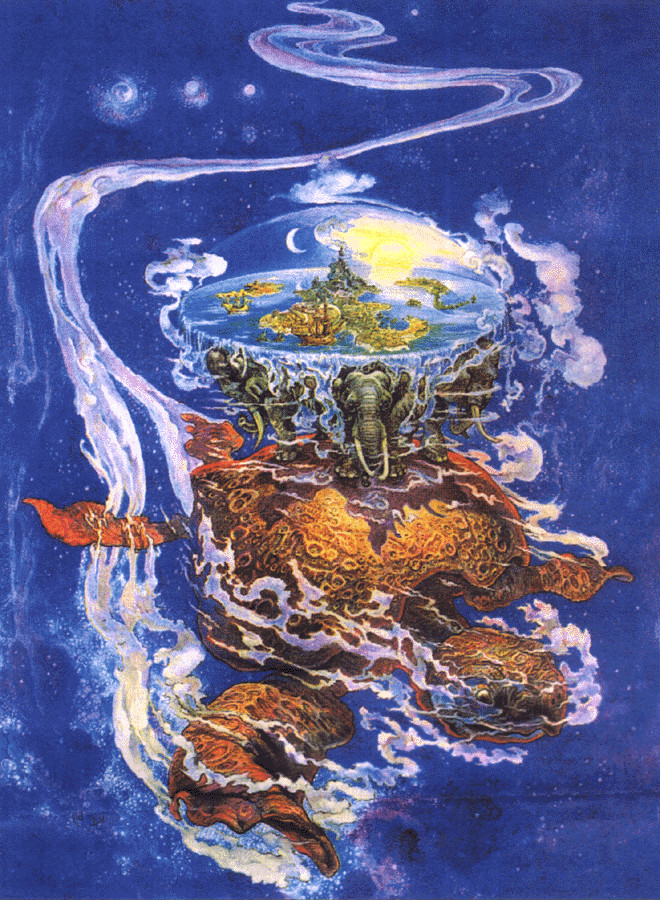
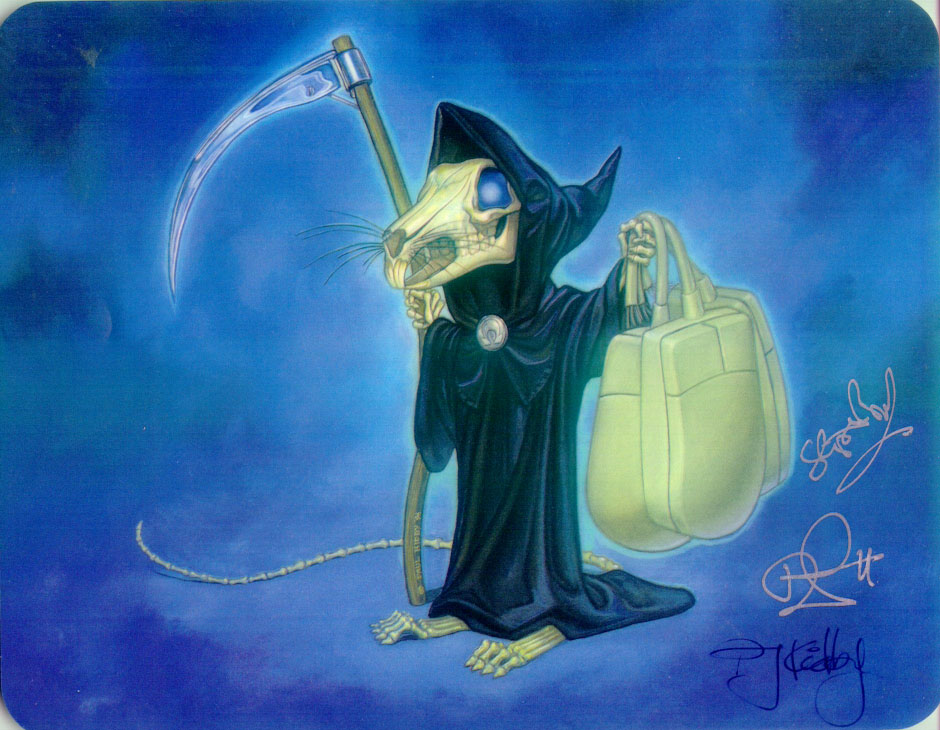
For those who don't know the Discworld: The world, which is a disc naturally, travels through space on the backs of four elephants that stand on the back of a giant turtle named Great A'Tuin. It looks something like this or this. It is a world filled with magic, but mostly with a lot of humor. Like the Tolkien novels, the setting isn't more than that: a setting in which a story is being told. That's also where the analogy between the two authors ends. The writings of Pratchett are mostly witty and satirical, full of references to literature, world events and (pop) culture. I would urge anyone to read one of his books. If you like fantasy, the world he has invented is rich and filled with colorful characters; if you don't, there's more going on than wizards, witches, trolls, librarians, assassins, and Death (with his horse Binky and the Death of Rats as companions).

Anyway, I'm very pleased that this stroke was only minor, and I hope that he will be around for some time and keeps churning out books. For more info, check out LSpace (and its Wiki), his profile at Bebo, the site of his American publisher, Discworld Monthly Newsletter, and the Guild of Fans and Disciples (GOFAD).